
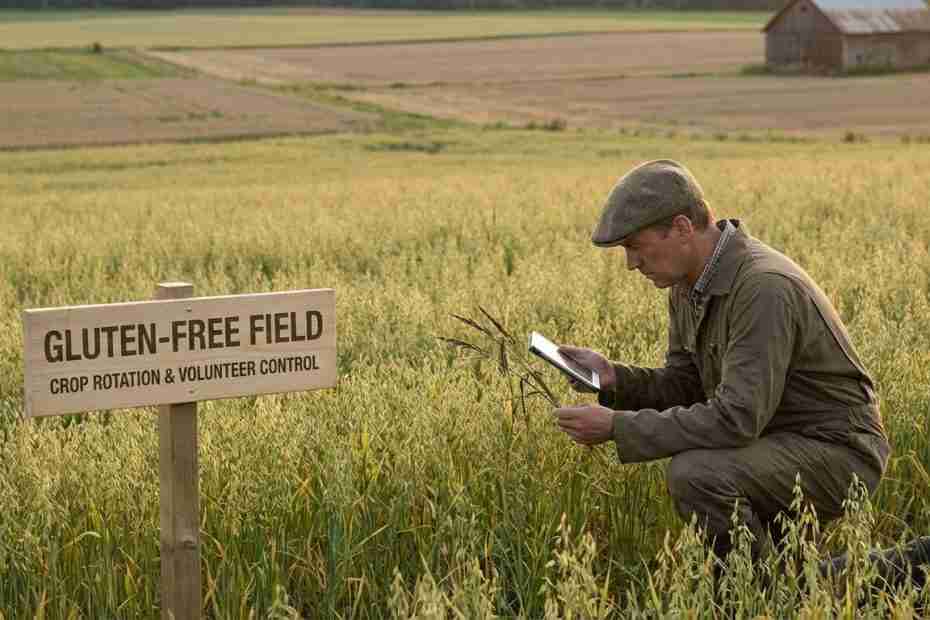
Crop rotation protects gluten-free purity when you control what was planted before oats, prevent “volunteer” wheat or barley from showing up in the next crop, and lock down shared equipment, storage, and processing. Done well, rotation supports soil performance and still keeps gluten below the U.S. gluten-free threshold.
You’re going to get a field-to-facility view of where gluten contamination actually comes from, why oats are the flashpoint, and how rotation decisions connect to harvest clean-out, transport, testing, labeling, and certification. You’ll also get practical buying rules if you’re sourcing ingredients, plus practical production rules if you’re building a gluten-free supply chain.
How Does Crop Rotation Affect Gluten-Free Purity In Grains Like Oats?
Crop rotation affects gluten-free purity through one uncomfortable reality: grains don’t respect your labeling goals. If oats follow wheat, barley, or rye, you can end up with “volunteer” gluten grains, plants that sprout from leftover seed in the soil, hiding in plain sight until they head out. Once that happens, harvest turns a small field mistake into a measurable ppm problem.
Rotation also shapes your weed-control program, which shapes how clean your stand stays. A rotation that reduces grass weeds helps you keep foreign heads out of the crop, yet the rotation still has to be designed with gluten control in mind. When you plan rotations for gluten-free markets, you’re planning for agronomy and allergen control at the same time, with no room for shortcuts.
There’s also a business-side effect that gets overlooked: rotation choices influence whether you can maintain segregation. If your farm runs wheat one year and oats the next, odds are your combines, grain carts, trucks, bins, augers, and elevators are also switching back and forth. That switching creates repeated cross-contact points that you must manage with validated cleaning, documented scheduling, and inspection, not informal “good enough” clean-outs.
If you’re buying oats, rotation is still relevant even if you never visit a farm. Your supplier’s rotation rules influence how often they find stray kernels during intake screening, how hard they must lean on sorting, and how much testing they need to do to keep you inside spec. When rotation is sloppy, your risk gets pushed downstream into sorting and lab testing, and that raises cost while still leaving uncertainty.
If Oats Are Naturally Gluten-Free, Why Do They Still Cause Gluten Exposure For People With Celiac Disease?
Oats are naturally gluten-free, yet your exposure risk comes from contamination, not from the oat itself. Cross-contact happens in the field from volunteer wheat or barley, at harvest from residue left in combines and headers, in transport from shared trucks and trailers, and in storage from shared bins and elevators. By the time oats reach a mill, a “clean” ingredient can become a blended commodity stream unless the entire chain is controlled.
The regulatory piece matters because it defines what “gluten-free” means in the U.S. Under FDA rules, a gluten-free claim means the food must meet the gluten-free definition in regulation and contain less than 20 parts per million gluten, including unavoidable presence below that level. The claim is voluntary, yet once it’s on pack, the manufacturer is responsible for compliance. You’re not buying a vibe, you’re buying a legal promise tied to a measurable threshold.
One detail you should treat as operationally important: the FDA does not require manufacturers to test to make a gluten-free claim. Companies can use testing as a control tool, yet the rule does not force routine batch-by-batch testing across all products. That’s one reason supply chain controls, audits, and certification programs carry weight when you’re trying to prevent failures, not just react to them after a complaint.
From a practical standpoint, oats are also a “high-risk naturally gluten-free” ingredient. Fresh produce doesn’t share combines and grain elevators. Oats do. If you’re advising consumers, the cleanest rule is to treat unlabeled oats as a cross-contact risk unless you have supplier proof that the chain is controlled and verified.
What Is “Purity Protocol” Oats, And How Is It Different From Regular Crop Rotation?
Purity Protocol oats are produced under a controlled system that starts at seed and field selection and continues through harvest, transport, storage, processing, and verification. Regular crop rotation aims at soil health and yield stability, yet Purity Protocol adds gluten control objectives that change what you plant, where you plant it, and how you handle it. You’re not just rotating crops, you’re building a documented ingredient identity that survives the entire journey to finished product.
A concrete marker you can look for in a serious program is field isolation and multi-year restrictions. One example described by Avena Foods is the use of mandatory isolation strips around fields, with a requirement that no gluten crop can be grown there for the last three years, paired with tracking through farm operations, transportation, and processing at certified gluten-free plants. That “three-year” element matters because it’s designed to reduce volunteer pressure and cross-contact risk, not just manage nutrients.
Purity Protocol also changes your traceability posture. Commodity oats can disappear into a bulk stream where “average quality” is acceptable. Purity systems keep lot integrity, require documentation at each handoff, and use testing strategically at intake and finished product to confirm controls are working. When you’re responsible for gluten-free compliance, traceability turns from a nice-to-have into your operational insurance policy.
From a sustainability angle, Purity Protocol does not automatically mean monoculture. You can still rotate with pulses, oilseeds, or other non-gluten crops, then return to oats under controlled rules. The difference is that your rotation plan is built around prevention, segregation, and verification, not around sorting out contamination after it happens.
Is Optical Sorting Enough, Or Do You Need Dedicated Crop Rotation Rules For True Gluten-Free Purity?
Optical sorting can reduce contamination, yet it’s not a substitute for upstream control when you’re targeting consistent gluten-free purity. Sorting works after commingling has already occurred, which means your risk has already entered the lot. If your process philosophy is “we’ll clean it up later,” you’re accepting a higher probability of misses, especially when kernels are similar in size or when contamination isn’t uniform across the load.
Dedicated rotation rules reduce how much contamination you must remove in the first place. If the prior crop history, isolation practices, and volunteer control are tight, then sorting becomes a polishing step, not a rescue mission. That difference shows up in lab results and in consistency across lots, which is what brand owners and ingredient buyers actually pay for.
Sorting also doesn’t touch other cross-contact points. A clean field can still get contaminated by a dirty auger, a shared truck, or a bin that once held wheat. Rotation rules address one major entry route, volunteers in the field, yet you still need an end-to-end control plan for equipment, storage, and processing lines.
If you’re deciding what to accept as a buyer, the most defensible stance is to prefer systems that prevent contamination upstream, then verify with testing. Sorting-only supply chains can work for some risk tolerances, yet they are harder to defend when you need repeatable low ppm performance and strong documentation for audits, customer requirements, or retailer standards.
What Does “Gluten-Free” Legally Mean In The U.S., And Is It The Same As “Certified Gluten-Free”?
In the U.S., “gluten-free” is a labeling claim regulated by the FDA. The rule defines gluten-free and sets the threshold at less than 20 ppm gluten, with ingredient-related conditions in the definition. The claim is voluntary, yet if you use it, you’re accountable for meeting the standard and for preventing misbranding.
Certification is separate from the FDA claim. A certification program is a third-party system that typically adds audits, documentation requirements, and ongoing verification, and it may apply a stricter gluten limit than the FDA threshold. The FDA also explicitly notes that the regulation does not require manufacturers to test, even though they remain responsible for compliance, which is why many manufacturers use testing, supplier COAs, and certification programs as control tools.
If you sell internationally or supply global brands, you also need to understand that “gluten-free” alignment exists across markets, yet trademarks and licensing programs add extra requirements. AOECS describes EU labeling rules based on Codex with a maximum of 20 ppm for gluten-free claims, and it ties use of the Crossed Grain Trademark to meeting its standard. That matters when you’re building one supply chain meant to satisfy multiple customer expectations.
When you’re advising shoppers, a practical distinction helps: “gluten-free” on pack means the product should meet the FDA standard, and “certified gluten-free” adds an external verification layer that many consumers trust more. When you’re advising brands, certification can simplify retailer conversations and reduce dispute risk when a lot needs to be defended with paperwork.
What Are The Biggest Contamination Points Farmers And Processors Watch For From Field To Facility?
The biggest contamination points repeat across almost every oat supply chain: field volunteers, shared harvest equipment, shared transport, shared storage, and shared processing lines. Field volunteers matter because they create true commingling at the source, where a few heads of wheat can travel with the oats and survive into finished product if not detected. If you want gluten-free purity, you treat volunteer management as a core control, not a seasonal annoyance.
Harvest equipment is the next gate. Combines and headers trap grain in multiple places, and grain handling systems on-farm and at elevators can retain residue in dead zones. If you run wheat and then oats, you need a clean-out procedure that’s written, trained, timed, inspected, and documented, with accountability for when it was performed and how it was verified.
Transport and storage introduce silent commingling risk. Trucks, rail cars, totes, augers, and bins can carry residual grain and dust. A single “we usually haul wheat” trailer can undo a clean field in one load. If you’re building a premium gluten-free ingredient program, you schedule clean loads, use dedicated or verified-clean assets, and maintain a paper trail that matches each lot.
Processing is where your controls either hold or fail loudly. Mills and food plants can manage gluten with segregation, controlled traffic, validated sanitation, and testing plans, yet the inputs still matter. When you combine disciplined upstream controls with disciplined plant controls, your testing becomes confirmation rather than discovery.
Can Crop Rotation Be Sustainable And Gluten-Safe, And What Does A Best-Practice Rotation Look Like?
You can run rotation for soil performance and still protect gluten-free purity, yet you have to set non-negotiable rules. Your oat acres need a controlled crop history, a plan for volunteer suppression, and boundaries that reduce the chance of gluten grains migrating into your oat stand. Your sustainability goals, soil cover, reduced chemical pressure, and nutrient management, remain achievable when rotation is designed around a gluten-free market spec.
A best-practice rotation for gluten-free oats typically prioritizes non-gluten predecessors and clear separation from wheat and barley production. Legumes can support nitrogen, oilseeds can break pest cycles, and cover crops can support erosion control, yet you still need to choose species and seed sources carefully. Contaminated cover crop seed is an avoidable mistake that shows up later as volunteer pressure and foreign material at harvest.
Operationally, you also need a segregation plan that matches the rotation plan. If your farm grows wheat somewhere, you schedule gluten-free oats after full equipment clean-out, you designate storage for gluten-free lots, and you control transport assets. You back it up with documentation that can be audited, because sustainable agriculture claims and gluten-free claims both collapse when you can’t prove what happened.
Many buyers now expect sustainability and gluten control to coexist. That pushes the industry toward protocols that pair traceability with measurable outcomes. When rotation, segregation, and verification live in the same management system, you can deliver oats that meet gluten requirements without sacrificing the agronomic benefits that keep farms viable.
How Does Crop Rotation Help Keep Oats Gluten-Free?
- Choose non-gluten prior crops
- Prevent volunteer wheat or barley
- Segregate equipment, bins, transport
- Verify with testing and traceability
Build A Rotation Plan That Protects Your Label And Your Customer
If you want gluten-free purity, you have to manage rotation as a contamination control, not just an agronomy preference. Oats stay safer when you control field history, suppress volunteers, and prevent cross-contact through harvest, hauling, storage, and processing. Your labeling obligations also matter: FDA gluten-free claims tie you to less than 20 ppm gluten, and the rule puts responsibility on the company even without a testing mandate. When you add certification, disciplined documentation, audits, and verification tighten performance and simplify buyer trust. Set your specs, demand traceability, and treat every handoff as a control point, then your rotation program becomes a sustainable advantage instead of a recurring risk.
References
- Questions and Answers on the Gluten-Free Food Labeling Final Rule | FDA
- 3 Tips for Gluten-Free Label Reading | Gluten Intolerance Group
- Avena Purity Protocol | Avena Foods
- Gluten Free Certification | AOECS
- Gluten-free Certification | American Society of Baking
- From experience how safe are oats that are not labeled gluten free? | Reddit
- Oat Contamination | Reddit
- What makes this oat milk not gluten free?? | Reddit
- Experience with oats | Reddit
- Avena Regen Ag Protocol | Avena Foods