
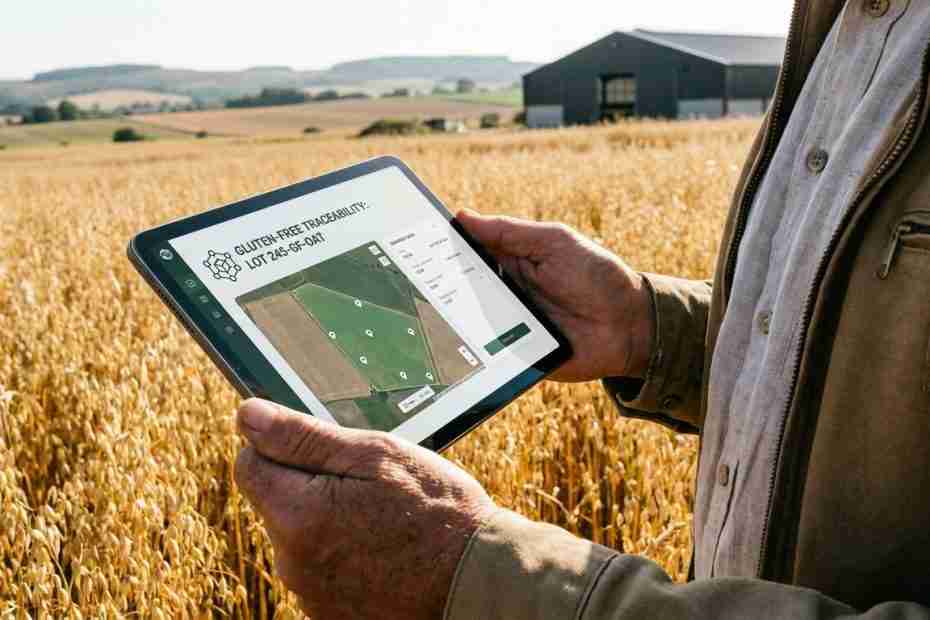
Gluten-free farming technology will make oat production safer by preventing gluten cross-contact in the field, verifying grain with advanced sorting and testing, and keeping oats separated through transport, storage, and milling.
The future of oat production depends on trust as much as yield. If you buy, grow, process, or formulate with oats, you need to understand where gluten risk enters the supply chain and which innovations reduce that risk before oats become oatmeal, flour, granola, or oat milk.
Are Oats Naturally Gluten-Free, And Why Do They Sometimes Contain Gluten?
Oats are naturally gluten-free, but they can contain gluten when they touch wheat, barley, or rye during growing, harvest, storage, transport, processing, or preparation. For people with celiac disease, oats need to be specifically gluten-free rather than assumed safe.
This is why oat production is different from producing a naturally gluten-free crop in isolation. A standard oat field can sit near gluten-containing grains, follow them in rotation, or share equipment that previously handled them. A few stray kernels can move through combines, trucks, bins, augers, mills, and packaging lines. Gluten-free oat production has to control the whole path, not just the crop species.
The National Institute of Diabetes and Digestive and Kidney Diseases says most people with celiac disease can safely eat moderate amounts of oats, but those oats should be gluten-free due to common cross-contact with gluten-containing grains. That distinction matters for food companies and farms because “oats” and “gluten-free oats” are not the same product category. One is a commodity crop. The other is a controlled supply chain.
What Makes Oat Milk Not Gluten-Free If It Starts With Oats And Water?
Oat milk can fail gluten-free expectations when the oats were not grown, handled, processed, or tested under gluten-free controls. A short ingredient list does not prove the grain supply was protected.
This is one reason consumers ask why a product made from oats and water may not be safe for a gluten-free diet. The risk usually starts before the liquid product exists. Oats may pass through shared grain elevators, shared trucks, shared bins, or shared milling equipment. If the brand cannot verify its oat source and testing plan, the final drink can carry uncertainty.
For processors, the future of gluten-free farming technology will push more verification upstream. Instead of relying only on final product testing, buyers will expect records from seed selection, field history, harvest cleaning, transport seals, storage segregation, and lot testing. That record trail makes it easier to explain why one oat milk is gluten-free and another one is not. It also gives consumers a clearer reason to trust the label.
What Is The Difference Between Purity Protocol Oats And Sorted Oats?
Purity protocol oats are managed to prevent gluten cross-contact from the field forward, and sorted oats rely on post-harvest cleaning technologies to remove gluten-containing grains. The best programs often combine prevention, sorting, testing, and transparent records.
Purity protocol starts early. It can include dedicated or carefully selected seed, field history review, crop rotation planning, field inspection, dedicated equipment, clean transport, segregated bins, and controlled milling. The goal is to stop wheat, barley, and rye from entering the oat stream in the first place. That prevention mindset is attractive because it treats gluten risk as a farming and logistics issue, not only a factory issue.
Mechanical and optical sorting take a different route. These systems identify and remove foreign grain after harvest, often by size, shape, color, or imaging response. Gluten Free Watchdog has noted that oats are complicated and that buyers should pay attention to testing protocols, supplier practices, and transparency rather than trusting a single phrase on a package. For serious gluten-free oat production, sorting is useful, but it should not replace clean sourcing and documented handling.
How Do Farms Prevent Gluten Cross-Contact Before Oats Reach The Mill?
Farms reduce gluten cross-contact by controlling seed, field history, crop rotation, harvest equipment, transport, and storage. The strongest systems treat every transfer point as a place where risk can enter.
Field planning comes first. A grower producing gluten-free oats needs to know what grew in the field before, what grows nearby, and whether volunteer wheat, barley, or rye plants may appear. Field inspections help catch problems before harvest, especially when volunteers are easier to identify. Buffer planning can also reduce risk where neighboring crops raise concern.
Harvest and handling demand the same discipline. Combines, grain carts, trucks, augers, dryers, and bins can carry leftover kernels from previous crops. Clean-out records, dedicated equipment where possible, sealed loads, and identity-preserved storage make the difference between a generic oat lot and a gluten-free candidate lot. Technology helps, but paperwork and operating discipline still matter.
Can Technology Make Gluten-Free Oat Production More Reliable?
Yes, technology can make gluten-free oat production more reliable when it is used to prevent contamination, detect foreign grain, verify lots, and trace oats through the supply chain. The biggest gains come from connecting farm practices with processing data.
Optical sorting is one of the most practical tools already shaping the category. Modern sorters can remove kernels that look different from the target oat stream, which helps reduce wheat, barley, rye, and other foreign material. Hyperspectral imaging may add another layer by reading grain characteristics beyond normal visual inspection. These tools are useful because they can inspect grain at speed and support larger gluten-free oat programs.
Digital traceability is just as important. A gluten-free oat buyer wants to know which field produced the lot, which equipment handled it, where it was stored, and which tests were completed. Barcodes, lot-level databases, supplier audits, and electronic clean-out records can reduce confusion when grain moves across farms, elevators, mills, and food plants. The future of oat production will reward systems that make verification easy to review, not buried in scattered files.
How Will Breeding And Genomic Selection Shape Future Gluten-Free Oats?
Breeding and genomic selection can improve oat varieties for yield, disease resistance, uniformity, and processing quality, which supports more dependable gluten-free supply. They do not remove the need for strict gluten controls because cross-contact is still the main concern.
Gluten-free farming technology is not only about detecting contamination after harvest. Better oat varieties can help growers produce cleaner, more consistent crops with fewer agronomic problems. Uniform plant height, stronger standability, improved disease resistance, and predictable maturity can make fields easier to inspect and harvest. Cleaner harvests are easier to manage through sorting and milling.
Artificial intelligence and genomic tools can help breeding programs compare more traits across more lines. That matters for gluten-free oats because the market needs reliable quality, not just more bushels. Food processors want oats that behave consistently in flakes, flour, beverages, and ingredient systems. Growers want varieties that justify the extra management required for segregated production.
Will Gluten-Free Oats Become More Available And Affordable?
Gluten-free oats can become more available if supply chains scale without losing control. Affordability depends on acreage, export demand, testing costs, segregation costs, and how many buyers compete for verified oats.
The wider oat market gives you a useful reality check. United States Department of Agriculture Foreign Agricultural Service projections place world oat production in the tens of millions of metric tons, with the European Union, Canada, Russia, Australia, Brazil, and the United States among the major producers. Canada remains central to North American supply, and Agriculture and Agri-Food Canada reports that the United States is Canada’s largest grain-oat export market. That matters because gluten-free oat supply is built inside the broader oat market, not outside it.
United States oat production is much smaller than total world production, so domestic buyers often watch Canadian supply closely. Agriculture and Agri-Food Canada projects Canadian oat production to decline from one crop year to the next, and United States Department of Agriculture National Agricultural Statistics Service data shows United States production depends on seeded area and yield shifts. If processors want more verified gluten-free oats, they need contracts that reward farmers for identity preservation, clean storage, inspections, and added risk. Scale can lower unit costs, but only if verification remains intact.
Why Do Some People React Even To Labeled Gluten-Free Oats?
Some people with celiac disease report reactions even to labeled gluten-free oats, so medical guidance and product transparency matter. A label can reduce risk, but it does not answer every individual tolerance question.
The National Institute of Diabetes and Digestive and Kidney Diseases advises people with celiac disease to discuss oats with a doctor or dietitian. That advice fits the reality consumers describe in gluten-free communities: some people trust only certain brands, some avoid oats entirely, and some want to know whether a product used purity protocol oats or sorted oats. Their concern is not abstract. They are trying to avoid symptoms and choose foods they can eat with confidence.
For oat producers and brands, this means trust needs more than a package claim. Buyers may want to know whether oats were purity protocol, sorted, tested by lot, produced in a dedicated facility, or made with a supplier that publishes clear controls. If you work with gluten-free oats, make those answers easy to find. Clear sourcing language can reduce confusion and help careful consumers compare products without guessing.
What Makes Oats Gluten-Free?
Gluten-free oats require clean seed, controlled fields, inspected harvests, segregated storage, verified transport, sorting, testing, and traceable records from farm to finished product.
Where The Future Of Oat Production Is Heading
The future of oat production will belong to farms, mills, and brands that can prove control from field to package. Gluten-free farming technology will not replace careful management; it will make clean management easier to verify, measure, and scale. Purity protocol practices, optical sorting, hyperspectral imaging, genomic selection, lot testing, and digital traceability all solve different parts of the same problem. If you’re choosing oats as a consumer, buyer, or product developer, look for transparency across the supply chain rather than relying on a single label phrase. The strongest gluten-free oat systems will be the ones that prevent cross-contact early, confirm quality later, and document every step in between.
References
- National Institute of Diabetes and Digestive and Kidney Diseases: Eating, Diet, & Nutrition For Celiac Disease
- National Institute of Diabetes and Digestive and Kidney Diseases: Definition & Facts For Celiac Disease
- Gluten Free Watchdog: Updated Position Statement On Oats
- Agriculture And Agri-Food Canada: Canada Outlook For Principal Field Crops
- United States Department Of Agriculture Foreign Agricultural Service: Grain Circular
- United States Department Of Agriculture National Agricultural Statistics Service: Small Grains Summary
- Reddit Gluten-Free Community Discussion: What Makes This Oat Milk Not Gluten-Free?